
Episode 2: The Man Who Could Think
Over the next several days, the friends got to know Donovan — and slowly, carefully, a real friendship grew between them.
He came to their cell whenever he could, always at the quiet hours when the cameras cycled and the watching face's attention was elsewhere. At first he was cautious, testing them, but the more they talked, the more he trusted them — and the more they trusted him. He brought them better food, smuggled from his own rations. He told them small jokes, the first jokes anyone on Concordia had told in years. And in the dim quiet of the cell, the three of them talked — really talked — about everything, the way friends do.
"You have no idea," Donovan said one evening, sitting with them, "what it means to me to talk with someone who actually talks back. Someone who thinks. I've been alone — truly alone — for longer than I can remember. You two are the first real conversation I've had in fifteen years."
"But the whole planet is full of people," Tom said, puzzled. "How can you be alone?"
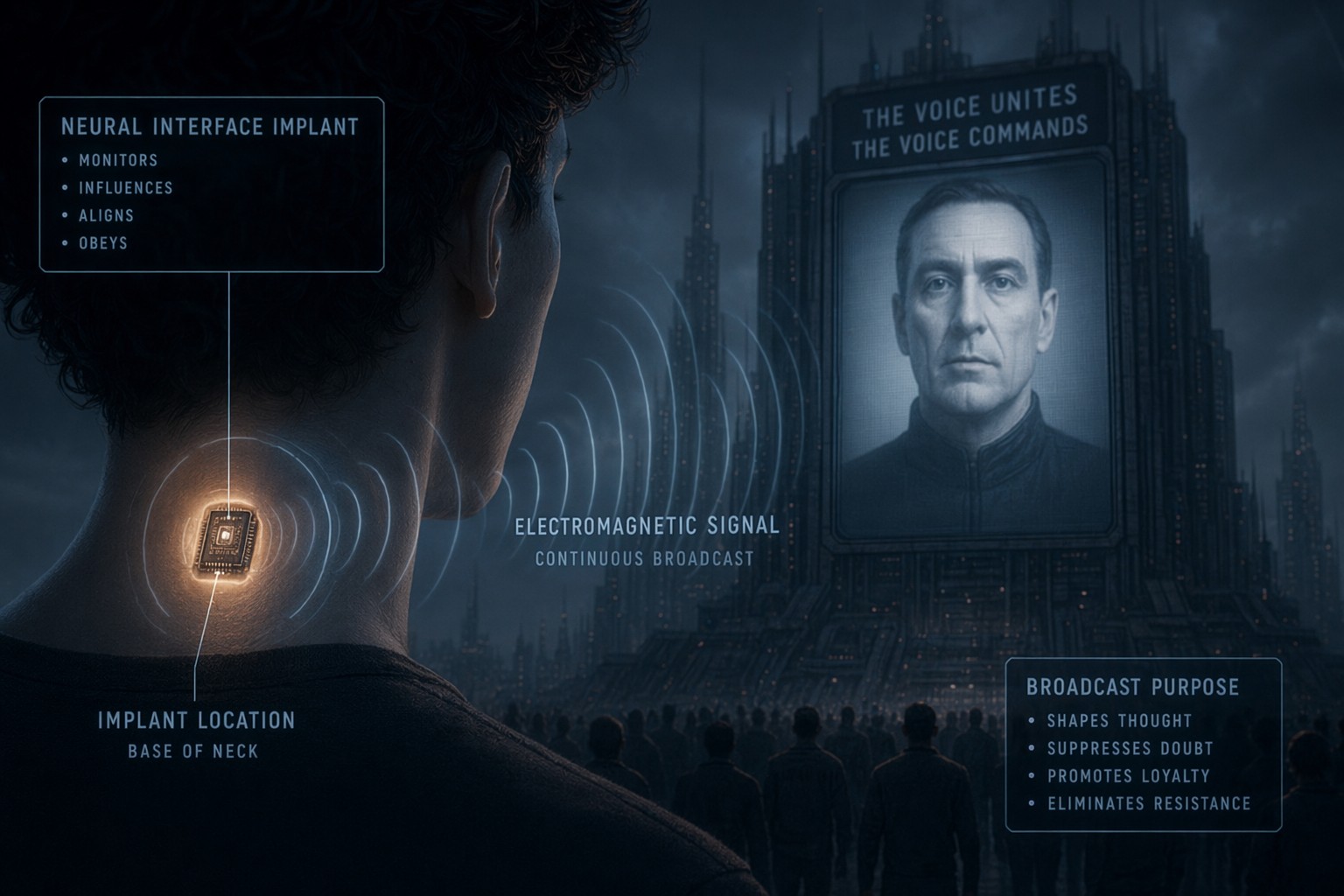
Donovan's face grew sad. "Because they don't think, little friend. Not really. Not anymore." He glanced up at the watching face on the screen, then leaned in close, and his voice dropped very low. "I'm going to tell you a secret. The biggest secret on Concordia. The secret that explains everything — why the people are so blank, why they obey, why they never question the face on the screen." He took a breath. "It's a device. A tiny one. Every single citizen of Concordia has one."
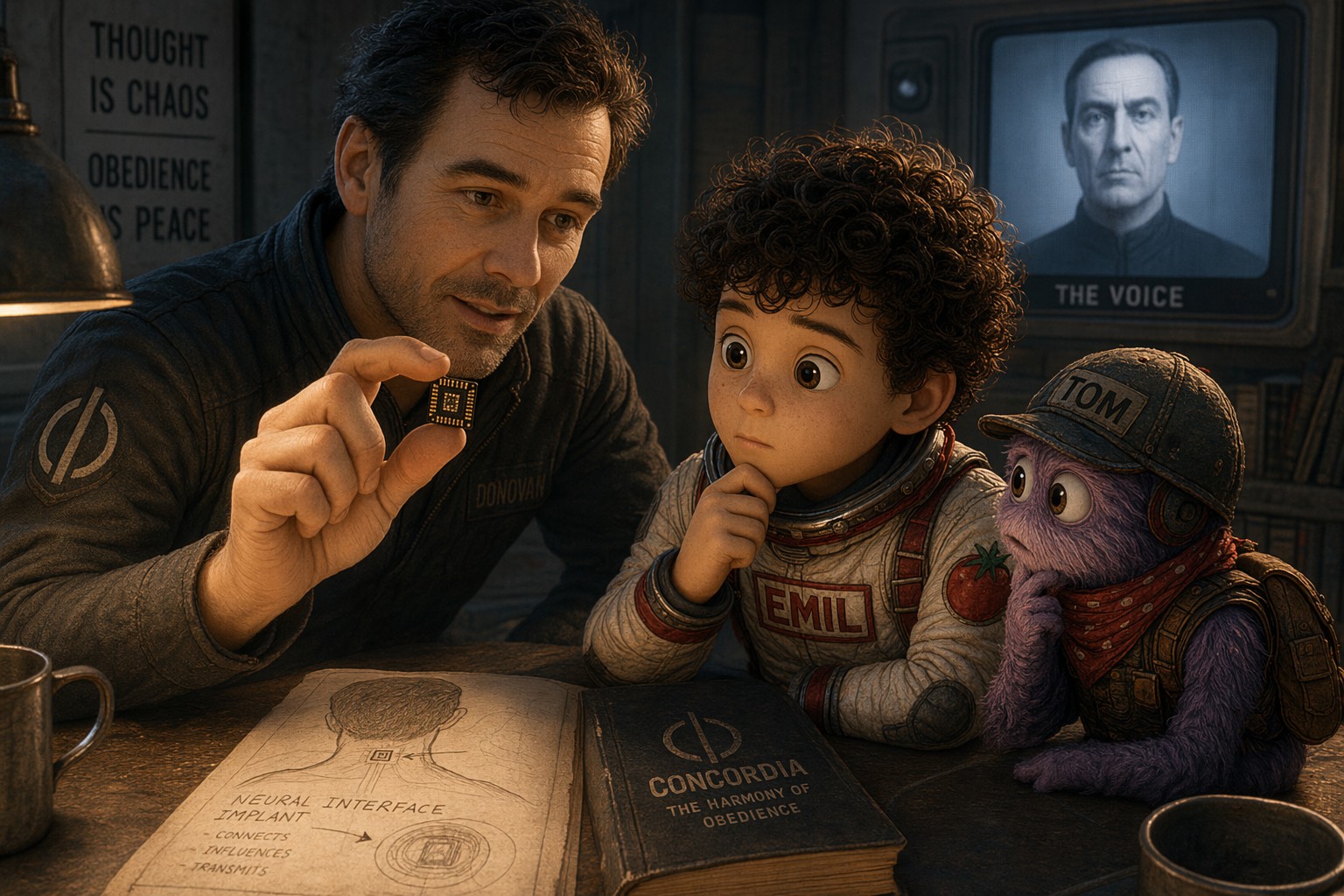
He held up his hand, and between his fingers he held a tiny computer chip, no bigger than a grain of rice — one he'd kept hidden for years.
"This is it," he said. "Every newborn child on Concordia, a few weeks after they're born, has one of these implanted into the back of their neck. The parents are told it's for their child's health and safety. And it is a kind of... safety. The safety of never having a dangerous thought." His jaw tightened. "Because this little device connects to the signal. The signal that comes from the screens, from the face. And it... it quiets them. It smooths away their doubts, their questions, their disagreements. It makes them calm, and content, and obedient. It lets the face on the screen reach right into their minds and tell them what to think — and they never even know it's happening. They think their thoughts are their own. But they're not. They're the face's thoughts. Every one."
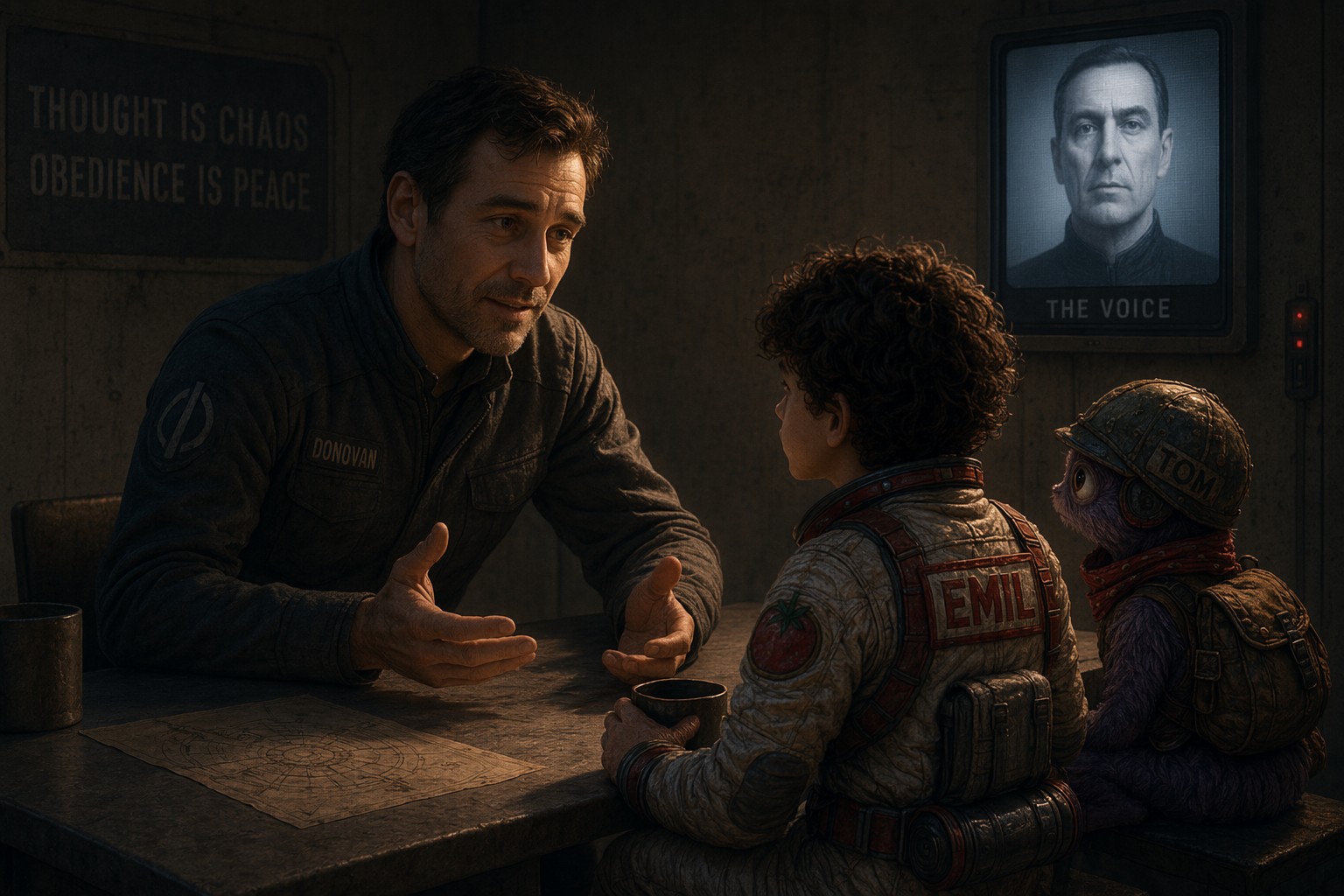
Emil felt a chill run down his spine. "A mind-control implant," he breathed. "In everyone. From birth. So that's how one face controls a whole world — it's not just watching them. It's inside their heads."
"Now you understand," Donovan said grimly. "There are no rebels on Concordia. No protesters. No free thinkers. Because the moment a child can think at all, the device makes sure they only think what they're told to think. The people believe they're happy. They believe they're free. They believe the face loves them and keeps them safe. And they'll believe whatever they're told — including that two harmless travelers are dangerous spies who want to steal their wealth." He shook his head. "The face says it, the signal carries it, the devices accept it — and so, for every person on this planet, it simply becomes true."
Tom stared at the little chip in horror. "But Donovan — you're not like them. You think for yourself. You ask questions. You make jokes." He hesitated. "Don't you have one of these devices?"
A shadow crossed Donovan's face, and he set the chip down. "No," he said quietly. "I don't. And that's the strangest, loneliest thing about my whole life." He rose and walked to the small window, gazing out over the grey, silent, obedient city. "When I was a young man, there was an accident. A bad one — machinery, at the factory where I worked. My neck was badly injured. The doctors saved my life, but in repairing the damage, they had to remove my device. And the injury left so much scarring that they could never put a new one back in. My neck simply won't accept it." He turned to face them. "So I became the only thing this world has no place for. A citizen who can think. Who can doubt. Who can see the screens for what they really are."
"That's why your eyes are different," Emil realized. "Why you're awake when everyone else is asleep. The signal can't reach you."
"Yes," Donovan said softly. "And do you know what they did, when they realized I was... defective?" His voice was bitter. "They couldn't kill me — Concordia prides itself on its 'peace.' But they couldn't let me walk free among the people either. A man who can think is dangerous — he might say something, ask something, plant a doubt in someone's mind. So they gave me the one job where my thinking does no harm. The one place where I'd only ever be around people who are already locked away." He gestured at the cell around them. "Here. The prison. I'm allowed to work here, guarding prisoners — and only here. I live in the prison. I eat in the prison. I will grow old and die in the prison. Not as a prisoner, exactly... but not free, either. Just... set aside. Forgotten. The one awake man on a sleeping world, locked away where my wakefulness can't infect anyone." He gave a hollow laugh. "For fifteen years, you two are the first people I've been able to truly talk to. Because you're the first people who could understand a word I said."
Emil and Tom were quiet, their hearts aching for the lonely man.
"Donovan," Emil said gently, "that's a terrible way to live. To be the only person on a whole world who's truly awake — and to be locked away for it."
"I made my peace with it long ago," Donovan said. But there was a flicker of something in his eyes — a longing he'd buried deep. "Still. There are things I've noticed, over the years. Things that don't add up. Things I've never been able to tell anyone, because there's never been anyone to tell." He came back and sat with them, lowering his voice. "Strange things happen on this world. And the strangest of all happens during the storms."
"Storms?" said Tom.
"Concordia gets great electrical storms, now and then," Donovan explained. "Rain, and thunder, and tremendous lightning. And on those days — on the days of the worst storms — the people change." His eyes were intent. "I've watched it happen, from the prison windows, for years. During a bad lightning storm, the citizens — just for a little while — start to act... differently. They look up. They look confused. Some of them stop in the street and rub the backs of their necks. Some of them, for a few minutes, almost seem to... to wake up. To remember they have minds of their own. I've even seen a few of them talk to each other — really talk — during a storm. And then the storm passes, and they go blank again, and they never remember it happened." He spread his hands. "I've never understood it. But it's the only crack I've ever seen in the perfect order of this world. The only time the people seem to come alive."
Emil's mind was racing now, the pieces clicking together. "Donovan," he said slowly, "the storms — the lightning — that's electricity. Powerful electrical energy, crackling through the air." He looked at the little chip on the bench. "And the devices in the people's necks are electronic. They run on the signal — an electromagnetic signal, from the screens." His eyes widened. "Don't you see? A big enough electrical storm — all that lightning — it must disrupt the signal. Scramble it. Interfere with the devices, just for a little while. And when the signal is disrupted... the people's own minds come back. Just for a few minutes. Until the storm passes and the signal takes hold again."
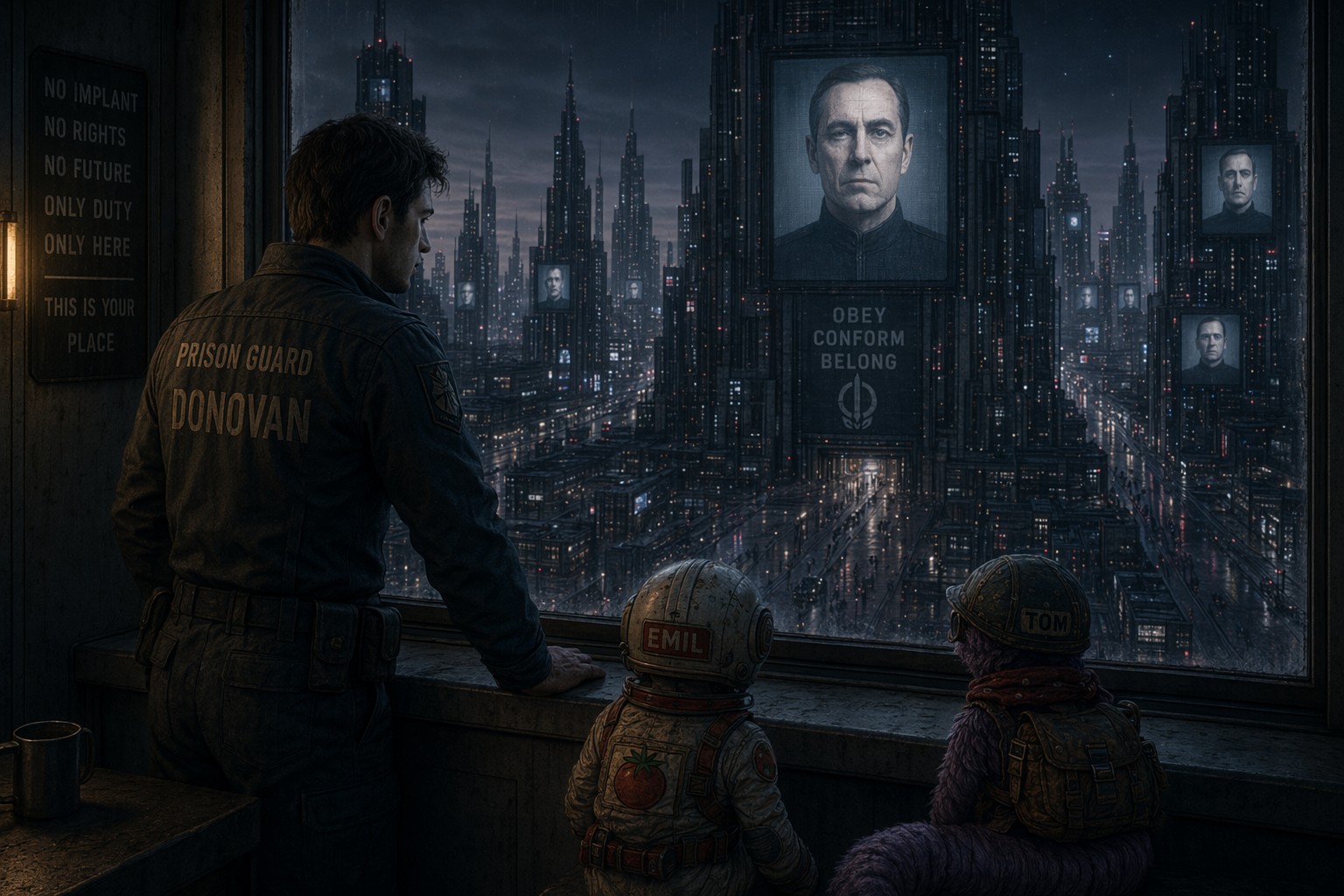
Donovan stared at him, and a look of dawning, astonished comprehension spread across his weathered face. "By all the stars," he whispered. "Fifteen years I've watched those storms, and I never understood why. But you've worked it out in a single evening. The lightning... it jams the signal. It frees them — for just a moment." He leaned forward, his eyes blazing with a hope he hadn't felt in years. "Which means... if the signal can be disrupted by a storm... then the signal can be destroyed. And if the signal were destroyed — permanently — then the devices would all go silent. And the people..." His voice caught. "The people would wake up. All of them. For good."
The three friends looked at each other in the dim cell, the enormous, dangerous, world-changing idea hanging in the air between them.
"That's it, isn't it?" Tom breathed. "That's how we free this whole world. We don't have to fight the face on the screen. We just have to find where the signal comes from — and destroy it."